


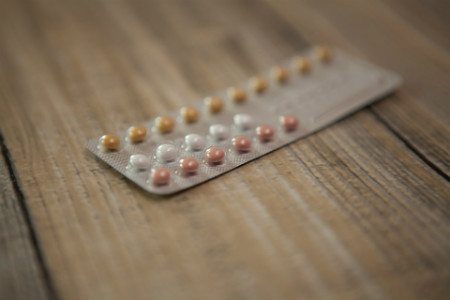
Lee S. Cohen, MD, and Hadine Joffe, MD, MSc, shared their expertise in reproductive health and oral contraceptives (OC) for Elle magazine’s recent article, “Against the Flow.” The article discusses Lybrel, the first continuous OC approved by the Food and Drug Administration (FDA). This new birth control pill has received attention because its continual low dose of estrogen and progestin completely eliminates monthly bleeding in women. It is 98 percent effective in preventing pregnancy, provides long-term health benefits, and eliminates what many women consider the “hassles” of menstruation.
Despite these advantages, some women are wary about eradicating their monthly “period”, an event that may feel like an essential part of being a woman. Dr. Joffe points out, however, that the standard Pill “is already messing with Mother Nature.” Bleeding during the week of inactive pills is due to withdrawal from the synthetic hormones instead of the natural cycle in which a woman ovulates, does not become pregnant, and then sheds the uterine lining. The article explains that although it may seem like a vital monthly occurrence, bleeding each month is actually not medically necessary when women are on an OC.
Continuous OCs like Lybrel may also prove to be useful for premenstrual syndrome (PMS) and/or premenstrual dysphoric disorder (PMDD).Dr. Cohen explains that premenstrual symptoms are caused by the brain’s response to fluctuating hormone levels, and women more sensitive to these fluctuations experience more dramatic symptoms.Therefore, taking a daily Pill with a constant hormone level may have the potential to reduce or even eliminate the symptoms of PMS and PMDD.
As approximately 80 percent of women use a birth control pill sometime in their life, continuous OCs appear to be a great option for women with mood or physical complaints premenstrually. But taking a Pill that appears to eliminate one’s natural cycle is a personal choice that each woman will have to make.
Katherine Donovan, BA




Do all birth control pills help with pre-menstrual symptoms like mood difficulties?
To date, only a pill called Yaz, a combination pill (it contains both estrogen and progestin) has been FDA-approved to treat PMDD. We don’t know yet whether other pills are effective at treating mood difficulties before menses, but they may be, and they are currently being studied.
I have suffered from PMS from teens onwards, my mother was also very badly affected. I have tried OCs on a number of occasions but found that they have affected me very badly, making me constantly over emotional, depressed and irritable. The only time in may life when I have enjoyed relative stability and sanity was after several months of breast feeding my children.
After years of no trouble with my period, I started developing PMS 3years ago at 26 y/o very badly with itchy skin that breaks out everywhere, unmanageable moods, uncomfortable cramps and bloating. This only happens 1 week before my period. I have tried to manage it with Dermatologist, Therapist, SSRI and all seem like bandaids to the underlaying problem of hormonal imbalance. I am now looking into Birth Control pills as a way to help. I am wondering if I should go to an endocrinologist or a gynocologist for this as it seems rather specialized. Any thoughts or help?
I’ve suffered for so many years and had no idea I had PMDD! I was taking Ortho-Micronor and eventually, my periods stopped. I suffered with anxiety and PTSD and never thought about my hormones at all. I stopped the Pill because I began to suffer break through bleeding, and over the last 6 month, my life, for one to two days a month, has become terrible. I want to end my life, I become negative, filled with despair, and a few days later, I’m back to being me. Its cost me relationships, career oportunitites and I’ve become anxious and upset just knowing that date will arive. I would love to have my ovaries removed, as I’m 43, but bone loss runs in my family and I’m worried over this. Also, what if we remove the ovaries and I still have mood swings, but worse, what if they happen all of the time? Also, are there any online groups for people like us?
Hi Lee,The symptoms you are decnribisg sound like also referred to as pre-menopause or early menopause. It is the length of time before and one year after the final menstrual period, during which ovarian hormonal patterns change. The average age at which irregular cycles develop is approximately age 47 but in many cases can start as early as 35 years old. Like menopause, perimenopause is a normal part of a woman’s life cycle. Generally, the ages at which your mother and older sisters began menopause and perimenopause are a good indication of when you might expect to start experiencing the symptoms of being premenopausal. If you smoke, it is likely that you will start perimenopause a year or two earlier than you would have if you didn’t smoke.You can read more about perimenopause and some of the .I hope you find the answers you are looking for!In health,Barbara at BodyLogicMD